

Revolutionary Research

Andrew Mullen, CEO
(image: Charco website)
Lucy Jung, founding CEO
Charco Neurotech was founded by a team of designers, engineers, and clinicians with the mission to help people Who suffer from long term health conditions. Our flagship innovation, the CUE1 device, originated as a project from the Innovation Design Engineering course at Imperial College London and the Royal college of Art. Supported by these universities and the University of Cambridge, we have gradually been able to evolve from a university project into a small company, whilst maintaining our core goal; to improve quality of life and bring smiles back for people with long-term conditions.
CUE1 has been developed to use focussed vibrotactile stimulation combined with the phenomenon of cueing to relieve the movement symptoms of Parkinson’s. These two phenomena have also been shown to improve other conditions such as multiple sclerosis, spinal cord injury, stroke and more. One condition that has not received much attention in the scientific literature relating to these phenomena however is orthostatic tremor (OT). Members of an OT facebook group recently came across CUE1 and were intrigued to see if it might help their condition. After meeting with the group, the Charco team, with the help of some of its members, arranged to visit one volunteer with OT to carry out some initial investigative testing with CUE1.
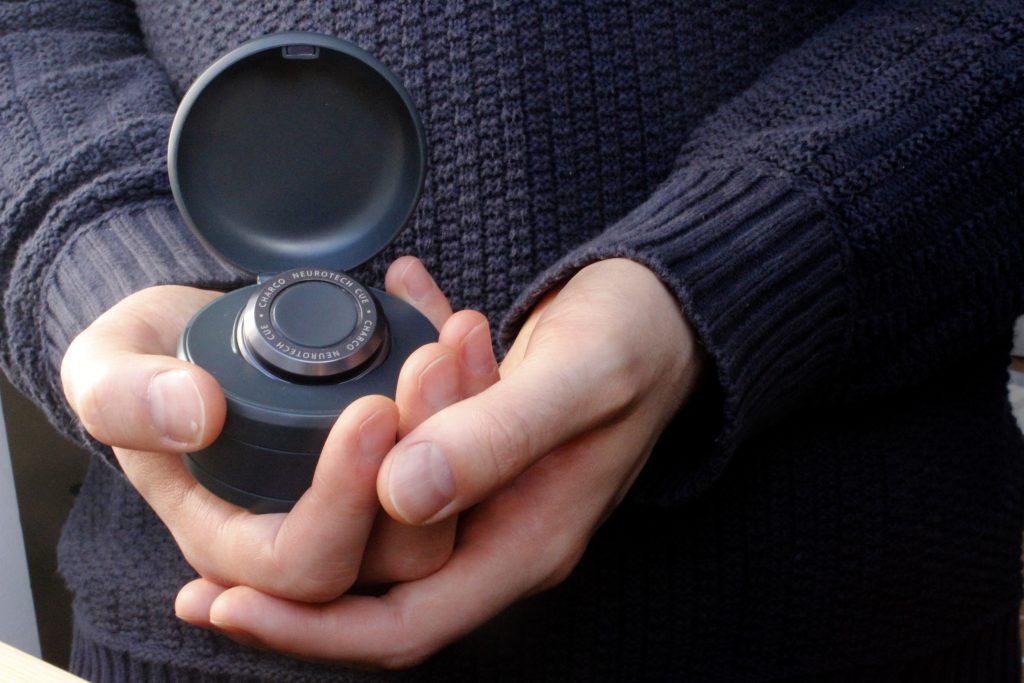
The volunteer’s OT symptoms consist of freeze of gait (FOG), decreased balance and stability when standing with her feet together, resting arm tremors as well as the characteristic standing leg tremors of OT. She shared how these symptoms make simple daily tasks very challenging, such as waiting in queues when shopping or climbing stairs. She often has to sit down when standing for too long due to her tremor and fatigue. She does not experience on/off periods, where symptoms fluctuate regularly throughout the day, but instead finds that her symptoms will gradually worsen towards the end of the day as tiredness sets in.
The volunteer is also a former physiotherapist and currently a clinician and so was able to suggest the best ways to measure her symptoms and any affect CUE1 had on them. The testing methods she chose included Single Leg Stand, Tandem Stand, Timed Up and Go (TUG), Tandem Walking, Standing with feet together and Turn on the Spot. The results showed a 31.2% increase in time she was able to balance on one leg, along with a 65.3% increase when standing with her feet together. This represented a scientifically significant improvement in the volunteer’s balance as well as her freezing episodes, shown by a 16.8% decrease in the time taken to turn on the spot. The results from these tests would suggest an overall improvement in balance and mobility which would extend to many other everyday tasks and hopefully give the volunteer an improved daily quality of life.
The volunteer felt that placing her hand on the CUE1 device whilst it was attached to her sternum gave a much more powerful vibration, that she felt was carried through her arm and helped her more. Although the testing was relatively informal and on only one person, we believe the results hold great promise for the effectiveness of CUE1 in helping the symptoms of OT, and warrant further investigation!
We continue to work our hardest to bring CUE1 to all those who need it, both with Parkinson’s and other compatible conditions as soon as we can. While it is not yet available, we expect to launch it in the UK and EU later this year. We hope you are as excited about the possibilities for CUE1 as we are, and if you would like to stay in touch with us, please sign up to our newsletter to keep updated on all our activity and news here: https://charconeurotech.com/. If you have any questions, please do contact us on info@charconeurotech.com.
We would want to thank OT group for participating in the testing, despite the cold weather and testing being long. Thank you so much for contributing to the research.
On Friday, 2nd August 2024, Lucy Jung attended her last meeting as CEO of Charco Neurotech. We are all sad to say goodbye to this dedicated, committed team member who has helped the Orthostatic Tremor UK Group in many ways. Thank you, Lucy, for attending our meeting in Birmingham and giving us your time and support to many of our members.
Andrew Mullen was introduced as the new CEO and he has promised to continue working with the Orthostatic Tremor Group.
Cue1 Initial Trial, by Anita Gale
At our conference in October 2023, I gave a presentation about the trial and this is a short summary.
Over 35 people with OT have been given a Cue1 on the trial.
Feedback has shown that even when you have two similar people, of a similar age, with a similar time from diagnosis and similar levels of fitness and exercise, the Cue can make a difference for one person but not for another.
Majority of people are wearing the Cue on their sternum. If they are wearing it elsewhere, it’s often due to a reaction to the patches. On the wrist, as you would wear a watch, held in place with a sports band or wrist support has worked for some. Female participants have also tucked it into their bra with similar results.
This is a sample of the responses I received when I asked :
If the Cue1 helps you, please give as many details and examples as you can.
- I feel it takes the edge of the tremor.
- The Cue1 has definitely helped when waiting, queuing in shops and supermarkets, whilst generally going about my day to day life I would even go as far as to say it seemed to give me the ability to do things like getting dressed without being worn out.
- Improvement to energy and tolerance. This had a knock-on effect giving improved patience and decreased anxiety. Picking items up off the floor was no longer an ‘age’ issue. After a shower I used to have to rest before getting dressed but since using CUE1 no rest is needed.
- It means I can stand for 4 minutes instead of 1, without having to sit down.
- Since wearing my CUE1 I can now have a quick shower without a tremor, I can stand in a queue with out trepidation for anything up to 15 minutes . I can stand still in the street for a few minutes to chat. My legs feel stronger. I feel more confident. I feel less stressed. I like the comfort of the vibration, it’s reassuring.
From conversation I have had with other Cue users I think it’s fair to say that some days you feel it gives you a lot of support whilst at other times you are not sure if it does anything.
Stress or illness seem to reduce or obliterate the help that the Cue gives us. Several people commented along the line of “It works best in my own environment, when I’m relaxed and at ease”.
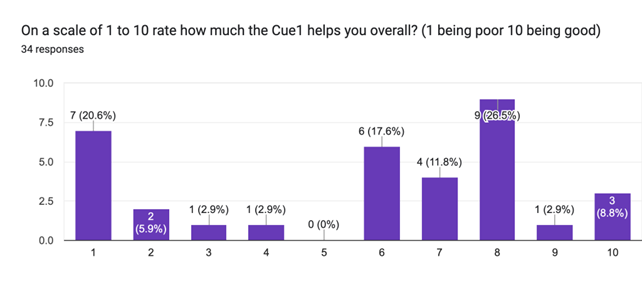
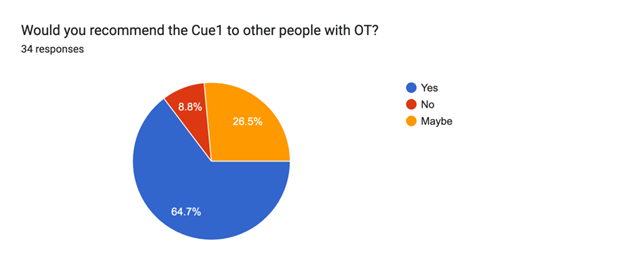
Participants have expressed their thanks to Charco for all the help and support they have given us. One person echoed the thoughts of others when they said “I’m so pleased to have been given the opportunity to try it out”
In 2024 the trial moved onto a second stage, which is clinical testing.
There is an OT device waiting list on the Charco website, which you will need to put your name on if you would like a Cue in the future.
Chris Cardus showed us how well he is getting on with his Cue, by getting out of his wheelchair and walked a short distance! We were all amazed. He feels that he has returned to how he was 8-10 years ago and it has made a huge impact on his life. Chris talked about how much his Cue is helping him, especially as it has enabled him to go abroad on holiday. He is hoping that a waterproof version can be developed to enable him to get into and out of pools and the sea easier, as well as enabling him to stand in the shower. He thanked Charco for making such a difference to his life.
Anita Gale
Results from OT/Cue1 Trial 2025
Loading Viewer…